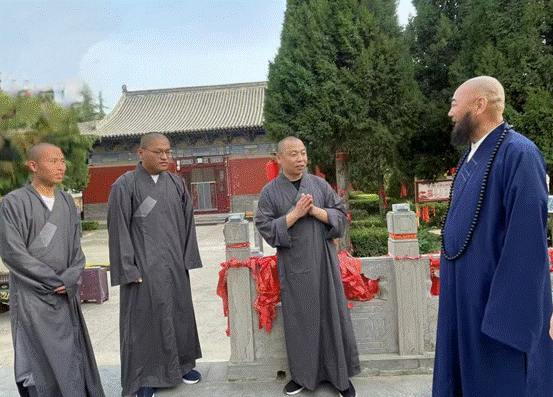
From May 7 to 9, Venerable Wanxing, abbot of Donghua Zen Temple, led a delegation from the Yellow River Golden Triangle zone—the heartland of Chinese ancestral culture in Yuncheng City, Shanxi Province—embarking on a pilgrimage to explore the origins of Chinese civilization. They delved deeply into the culture of the Chinese ancestors, advanced the integration of Buddhism with Chinese society, and promoted the excellent culture of the Chinese nation.
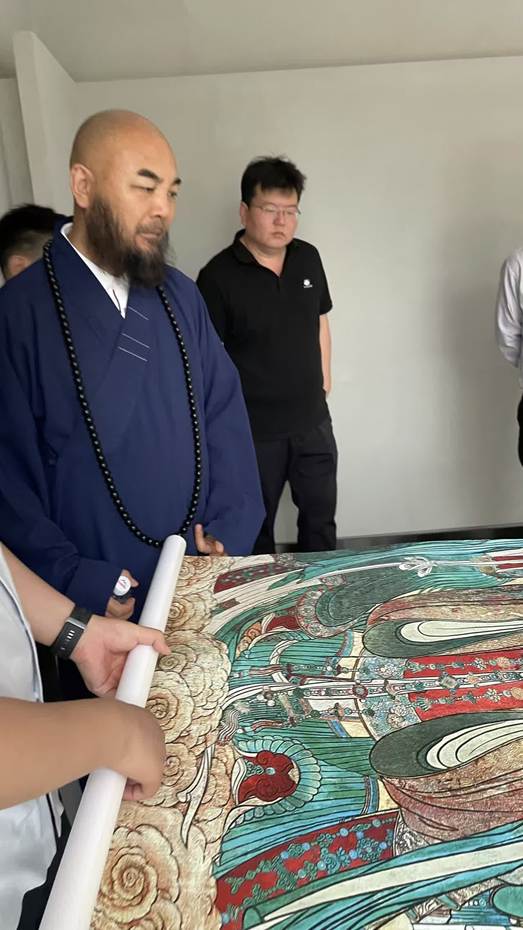
Stepping into the Yongle Palace (also known as the Palace of Eternal Sun and Longevity) in Ruicheng County, Shanxi Province, visitors are greeted by exquisitely large-scale murals. Reportedly, the murals cover a total area of 1,000 square meters, distributed across the Hall of the Ultimate Void, the Hall of the Three Pure Ones, the Hall of Pure Yang, and the Hall of Chongyang. Among them, the Hall of the Three Pure Ones is the main hall, with its interior murals covering a total area of 403.34 square meters, standing 4.26 meters high and stretching 94.68 meters long.
“The mural art of Yongle Palace represents both the crystallization and sublimation of culture, serving as a universal language. Created over a span of more than 100 years, these murals have become one of China’s ‘root arts,’ preserving millennia of Chinese civilization and continuously nourishing the progress of societal culture,” Venerable Wanxing remarked during his visit to the murals, noting that the Yongle murals, as a rare venerable piece in the history of world painting, represent an important contribution of Chinese cultural art to the world’s cultural arts. Donghua Zen Temple will also strengthen temple cultural education and cultural talent development from an artistic perspective, promoting the continuous advancement of Chinese cultural and artistic traditions for the new era.
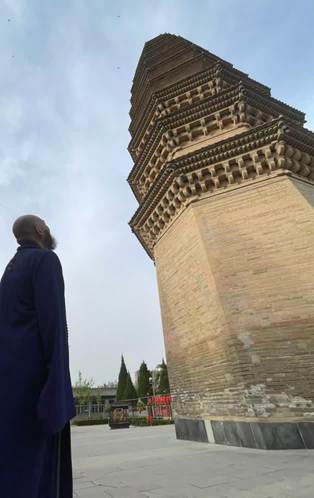
“The integration of Buddhist architecture with Chinese culture and art is one of the important manifestations of Buddhism’s assimilation into Chinese society.” Venerable Wanxing and his party then entered Shousheng Temple, one of the earliest Buddhist holy sites in China due to its enshrinement of the true body relics of Shakyamuni Buddha. Historically, Shousheng Temple was first established in the tenth year of the Eastern Han Dynasty (67 AD), while its relic pagoda was constructed during the Tiansheng reign of the Northern Song Dynasty (1023-1032 AD). The pagoda is unique for its iron bowl-shaped finial—the only one of its kind in China, and it ranks among the country’s oldest, highest-grade, and best-preserved pagodas housing true body relics. Despite withstanding 13 major earthquakes, the pagoda remains intact. The interior of the pagoda preserves Song Dynasty murals depicting themes of Buddhas, bodhisattvas, and devotees.
The “Morning Bell of the Pagoda Temple” within Shousheng Temple is listed as one of the “Eight Scenic Views of Ruicheng.” During the survey, Venerable Wanxing remarked that the morning bell has echoed for a thousand years at the heart of China’s ancestral culture. It embodies both the million-year-old light of human use of fire and the nurturing influence of nearly ten thousand years of Yellow River civilization, serving as a quintessential carrier of the nation’s spiritual heritage—a phenomenon rarely seen worldwide. “Our nation’s culture is a pride of all humanity and a shared cultural treasure. This is precisely the significance of our journey to learn from it.”(translator: Jiang Renfeng)