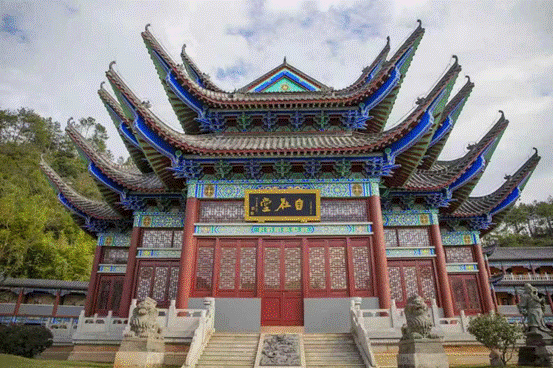
Nestled within the millennium-old Donghua Zen Temple lies the serene and solemn meditation hall—the Hall of Ease. Today, let us step into this space imbued with the wisdom of spiritual practice and explore connected sites along the path, such as the Three Sages Cave and Vulture Peak, to experience the spiritual heritage amidst the temple’s forests and mountains.

The Hall of Ease, also known as the Hall of Buddha Selection, is the seventh main hall of Donghua Zen Temple and serves as one of its core meditation spaces. Only after passing through the previous halls and meeting their respective criteria can practitioners qualify to enter this hall for practical cultivation. Upon successfully completing the training within, a monk can attain realization through practical engagement—becoming one who has achieved “great freedom” and transforming into a true monastic talent who thoroughly comprehends both Buddhist rituals and teachings. Monks who pass the examinations according to the sequence of practice can achieve a state of inner and outer unity.
In front of the gate of the Hall of Ease’s courtyard hangs a couplet personally inscribed by Master Wanxing, rich with Zen meaning:
Facing West: Sipping tea reveals one’s true heart; Amidst stick and shout, the Founder’s intent is clear. Horizontal Plaque: Attain Great Liberation
Facing East: Seeking Buddha, seeking Dharma, is seeking a false path; Be neither tense nor lax, nor dwell in between. Horizontal Plaque: Seek Nothing Outside
Continuing onward from the Hall of Ease, you will reach the Three Sages Cave. Originally named the Huineng Cave, legend has it that the Sixth Patriarch once visited and struck the cave entrance three times with his staff. While in retreat here, Master Wanxing attained a profound Zen realization and subsequently renamed it the Three Sages Cave. As stated in the Tao Te Ching, “From One comes Two, from Two comes Three, from Three comes all things.” Thus, the name “Three Sages Cave” signifies this site as the origin of Donghua Temple and the source from which countless accomplished practitioners have emerged over the centuries, representing the enduring lineage of Zen.
The Lion Mountain where the Three Sages Cave is located resembles a mighty lion swooping down from the sky, ready to attack. Three Sages Cave is precisely located at the lion’s mouth, with the viewing platform forming its lower jaw. A short distance farther lies Vulture Peak. The mountain was named by Master Zhiyao for its resonance with the spiritual energy of India’s Vulture Peak, where the Buddha once delivered teachings. When viewed from below, the entire mountain resembles a giant divine vulture spreading its wings for flight, with countless smaller vultures nestled among them, each like a vivid and lifelike arhat. (translator:Jiang Renfeng)