From May 7 to 9, Venerable Wanxing, the abbot of Donghua Zen Temple, led a delegation from the Yellow River Golden Triangle region in Yuncheng City, Shanxi Province—known as the heartland of Chinese ancestral culture—on a journey to explore the origins of Chinese civilization. They visited the Guangren King Temple, one of the four remaining Tang Dynasty wooden structures in China, to admire the architectural masterpiece known as “a thousand years in a single glance between mortise and tenon joints”; They also explored the Xihoudu Archaeological Site, the origin of “the first flame of Chinese civilization,” delving into the culture of the Yellow River basin and studying the origins and evolution of Chinese civilization.
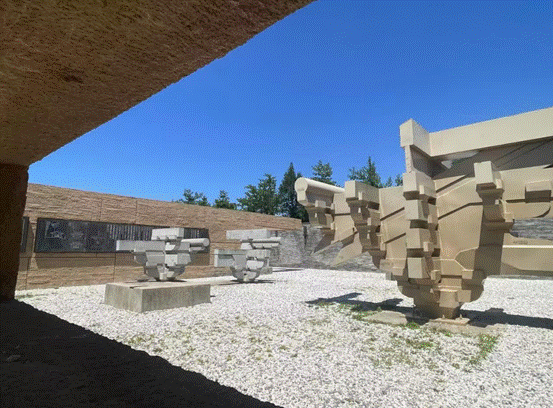
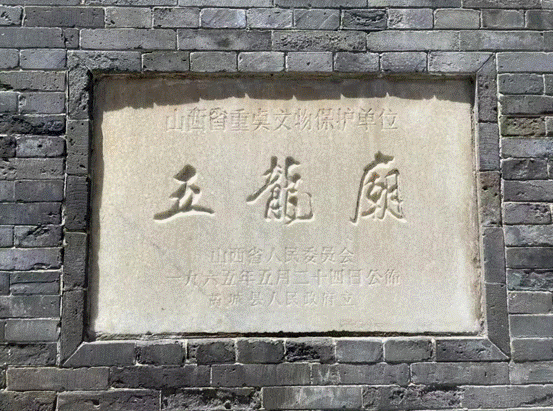
Located within the ruins of the ancient Wei City walls, 4 kilometers north of Ruicheng County in Yuncheng City, Shanxi Province, stands the Guangren King Temple (also known as the Five Dragons Temple). It is one of only four surviving Tang Dynasty wooden structures in China and the only extant Taoist architectural relic from the Tang period. Originally built in the fifth year of the Taihe era of the Tang Dynasty (831 AD), the temple regained attention in 2021 when it was featured as a location in the game Black Myth: Wukong. Its primary components—beams, framework, and bracket systems—are all original Tang constructions, bearing immense historical and artistic value. The bold bracket systems and gently sloping roof align closely with Tang building standards, making the structure a timeless architectural treasure reflecting millennia of history in a single glance.
“The Guangren King Temple allows us to personally experience the splendor of the Tang Dynasty, a golden age in the long history of the Chinese nation. The Tang Dynasty saw the emergence of numerous artists and inventors, who, together with the common people, formed a vibrant society leading the world, driving the innovative development and enduring influence of Chinese civilization.” During his visit, Venerable Wanxing noted that Buddhist culture also flourished during the Tang Dynasty, integrating into “Tang Dynasty culture” in a distinctly Chinese manner and reaching out to the world. The Sinicization of Buddhism manifested as a dual-cycle development of “bringing in” and “going out.”
Venerable Wanxing further explained that Donghua Zen Temple originated from a thousand-year-old ancient temple and has developed into a beautiful complex reflecting Ming and Qing architectural culture, benefiting from China’s reform and opening-up policy and the flourishing cultural development in the new era. Following the completion of its physical construction, the temple has strengthened innovation in cultural content development, allowing local residents and visitors to appreciate the profound wisdom and artistry of Chinese architectural culture during their tours.
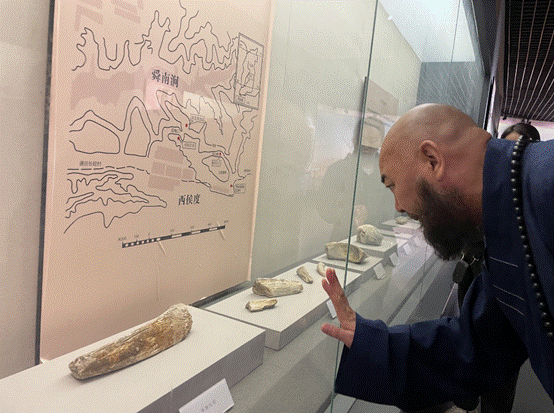
At the Xihoudu Archaeological Site, staff explained that it is one of China’s earliest known Early Paleolithic cultural remnants, dating back approximately 2.43 million years. It is recognized as the origin of “the first flame of Chinese civilization.” The staff also elaborated on how the Yellow River civilization belt between Mount Hua and Zhongtiao Mountain embodies the geographical meaning of “China”.
Venerable Wanxing listened attentively to the explanations and observed the fossil remains. Standing on the site platform, overlooking the peaks of Mount Hua and Zhongtiao Mountains, he remarked with emotion that the 2.43-million-year-old “first flame of Chinese civilization” is a profound source of cultural confidence. He reflected on the long evolution of ancient Chinese people from consuming raw meat to using tools and mastering fire—an arduous journey of struggling and integrating with nature. Moving forward, Donghua Zen Temple’s cultural initiatives will adopt a perspective of human history, integrating various cultural origins of China. Through incremental efforts in cultural dissemination, it will take the revitalization of the nation as its mission, strengthen learning, and earnestly practice cultural confidence and the common development of humanity.
It is reported that this root-seeking pilgrimage is one of the measures taken by Donghua Zen Temple to continuously refine its approach and practical system for the Sinicization of Buddhism through daily management and Dharma propagation. Through this journey, the temple has gained a deeper understanding of the origins and evolution of Chinese civilization, appreciating the profound beauty of the million-year history of humanity, the ten-thousand-year cultural history, and the over-five-thousand-year civilization on this land. (translator: Jiang Renfeng)